Tags
OVERVIEW
A lot happened in the energy industry in March. Here are the ten most important new stories on the topic of energy and solar storage, from government subsidies and interesting study results through to new energy storage projects.
1. Use of energy storage to be enshrined in the German Energy Industry Act (EnWG) (March 26, 2014)
At the opening of a conference on the topic of energy storage on March 25, 2014, Chairman of the Executive Board of the German Association of Energy and Water Industries (BDEW) Hildegard Müller called for power storage systems to be made exempt from grid consumption duties and criticized the lack of coordination between the German Federal Government and German state governments as an obstacle to the energy transition. North Rhine-Westphalia’s Environment Minister, Johannes Remmel, emphasized that the priority use of energy storage systems to integrate renewable energies into the energy mix and create grid stability must be enshrined in the German Energy Industry Act. In addition, he stated that grid operators should also be able to operate pumped storage power plants and back-up power plants and to receive financing via grid usage fees if such pumped storage power plants are primarily used for regulating the grid.
2. Researchers on the hunt for lithium alternatives (March 19, 2014)
Researchers from Switzerland and engineers from Siemens and the M+W Group are making progress in the production of high energy storage solutions. Fundamental research has also moved a step further forward through the creation of nanocrystals. Scientists believe that these represent a very promising alternative for future electrode material in batteries with high load capacity.
3. Japan funds energy storage (March 19, 2014)
After Germany, Japan is the second country to grant government subsidies for battery storage systems. Japan’s Ministry of Economy had recently announced plans to provide financial support to help drive the installation of 100 megawatts (MW) of energy storage capacity this year. The government intends to put nearly 100 million euros aside to do this.
4. Study examines the market development of storage systems (March 14, 2014)
While the market for photovoltaic storage systems has been slowly gathering momentum in Germany, other markets are still lagging behind. However, the on-site consumption and storage of solar power are also advancing in other European countries, like Great Britain and Italy, and are becoming real alternatives to grid feed-in. A good indicator for the market success of photovoltaic storage systems is how installers view the new technology. A study conducted by the market research institute EuPD Research found that homeowners interested in installing a PV system rely primarily on the views of the PV system installer when making their decision. The market development of storage systems to date in the most important European photovoltaics markets, and the attitudes of installers toward the new technology have now been analyzed for the study “European PV Storage Market Insights 2014”.
5. Experts discuss storage subsidies (March 14, 2014)
It is still unclear to what extent storage subsidization will progress this year. The German Solar Industry Association has investigated the scope of funding available for storage systems, why many customers are installing them without using subsidies and how much the systems cost. Experts are currently debating how power consumed on site must be treated for sales tax purposes.
6. Dortmund University launches “Storage in the City” project in Wunsiedel (March 11, 2014)
Dortmund University is opening a project office in Wunsiedel, north-east Bavaria. Researchers want to test how to make the city into an energy storage hotspot. In the “Storage in the City” project, the people of Dortmund are analyzing, for example, the use of hot water storage tanks, storage heating systems, batteries, and electric vehicles as storage media. The aim is not only to gather data on the generation of and demand for energy, but also to develop corresponding economical products as a result.
7. Europe’s largest green power battery park underway in Schwerin (March 11, 2014)
On March 11, 2014, construction started in Schwerin, Germany, on the technical structure for Europe’s largest green power battery with a capacity of 5 MW. The energy storage system is intended to offset fluctuating energy levels from wind and solar farms, such as those occurring as a result of calm or cloudy conditions, at one second intervals. To date, only conventional power plants have guaranteed a permanently steady flow of energy. According to calculations from the regional energy utility Wemag, the new battery park should be able to replace a conventional 50 MW turbine.
8. Experts disagree with EFI report (March 4, 2014)
In a report, 17 European experts disagree with statements made by the EFI Expert Commission for Research and Innovation and confirm that the EEG has supported the renewal of energy systems and driven forward innovation. The researchers involved, including those from Fraunhofer Institute for Systems and Innovation Research (ISI), pooled together their research findings from recent years in order to produce their statement.
9. Use of nanotechnology in energy storage systems (March 3, 2014)
On behalf of the International Electrotechnical Commission, the Fraunhofer Institute for Systems and Innovation Research (ISI) has been looking at the role that nanotechnology will play in solar energy and energy storage in the future. In the study, the ISI came to the conclusion that nanotechnology and nanomaterials will become more important in these sectors. By 2035, global energy demand is expected to rise by a third. At the same time, the aim is to cover an increasingly large portion of this energy demand using renewable sources. Storing renewable energy is therefore key. With the help of nanotechnology, storage capacities can be improved, material efficiencies boosted and manufacturing costs lowered.
10. Project on the benefits of solar storage systems for end users (March 3, 2014)
The project “Sol-ion+” is aimed at highlighting the benefits of solar storage systems for end users and for stabilizing distribution networks. As far back as 2008, the “Sol-ion” project generated results that led to the development of Bosch’s BPT-S 5 Hybrid PV storage system. The aim of the follow-up project “Sol-ion +” is to now prove that storing PV electricity can benefit end users and help stabilize distribution networks. Bosch Power Tec is responsible for development and project coordination, while the battery technology is provided by Saft Batterien, the German battery sales company of the Saft Group. The first phase involves developing a storage system for end users. A total of 17 battery storage systems are due to be installed as part of a field test in the Groß-Gerau district of the grid area operated by utility Überlandwerk Groß-Gerau GmbH (ÜWG). A combination of systems to support the grid, as well as individual end user systems will be installed in parallel. The project is set to run over four years and is funded by the German Federal Ministry for the Environment, Nature Conservation, Building and Nuclear Safety.
Related Posts
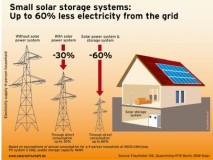
Does the grid really need batteries? This is currently a very controversial question. Some experts even consider the technology to be detrimental and that’s why they are strictly rejecting Germany’s planned incentives. Fraunhofer Institute for Solar Energy Systems (ISE) counters this argument in its new Speicherstudie 2013 (study on storage systems): Batteries can actually take… read more
