Tags
OVERVIEW
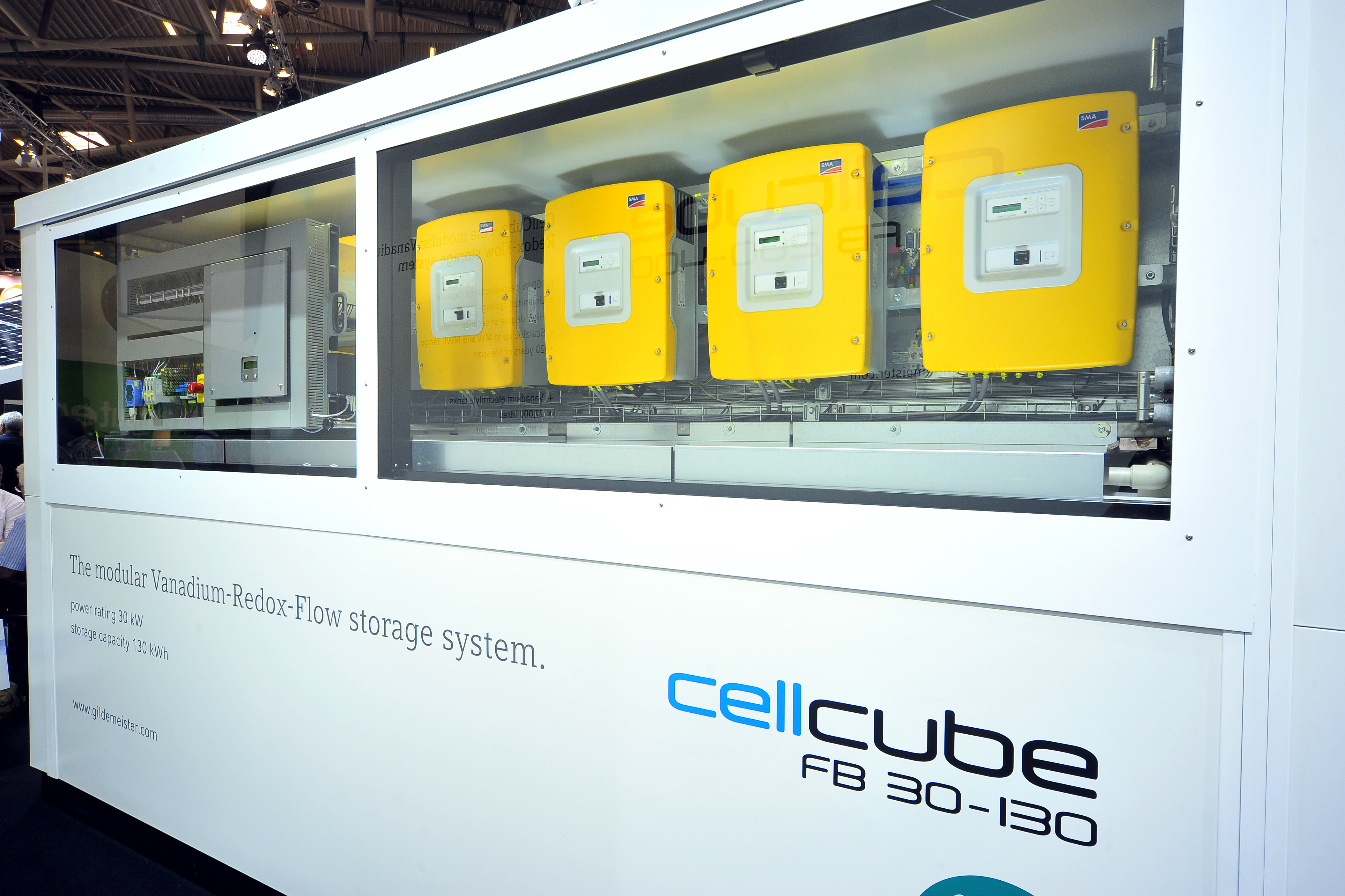
Gildemeister cellcube FB 30-130 at Intersolar Europe 2013 (Source: Solar Promotion GmbH)
For photovoltaics to play a leading role in the energy transition, energy storage systems need to reduce the burden on the grid and provide operating reserves, as well as being equipped with an intelligent energy management system that coordinates their usage. Will the industry succeed in developing the necessary technical solutions?
In a renewable power supply system, the grid has a variety of additional tasks. It is therefore essential to develop solutions that compensate for fluctuations in wind and solar power, enable millions of decentralized power generators to feed in electricity and adapt consumption to the power supply. In doing so, a high level of supply security at acceptable prices must be maintained. Can researchers and engineers rise to the challenge?
The clock is ticking: “In some rural regions, power lines are already being overburdened, with threats of either high grid expansion costs or a limited increase in photovoltaics,” said Philipp Schröder, Sales Manager of Prosol Invest in Allgäu, Germany, during the energy storage systems event at Intersolar’s PV ENERGY WORLD special exhibit. Intelligent battery storage systems may be the answer. During the middle part of the day, they absorb solar power that is “critical for the grid”, before rereleasing it to consumers when it is actually needed. With this is mind, the industry is putting its weight behind this solution. Companies are developing systems at all levels for use in single-family homes and the commercial sector alike. The great efforts being made by the solar industry were reflected at Intersolar. Over 200 companies coming under the product category of energy storage systems, including 76 battery manufacturers, presented themselves at the world’s leading exhibition for the solar industry.
The latest trends include lithium-ion and lead-acid batteries with integrated energy managers, which can also take into account weather conditions and create yield forecasts from this data. This is especially important for the act of limiting photovoltaic installations to 60% of their possible output – a requirement of the German government’s new incentive scheme. This technology already exists in Prosol’s Solarbattery, which boasts a storage capacity of up to 60 kilowatt hours (kWh). In these systems, the energy manager can access weather reports online, which are evaluated by an algorithm and then converted into a yield forecast specific to the photovoltaic installation.
Meanwhile, companies like Saft and Gildemeister are working on ways to provide megawatt solar parks with intelligent storage technologies on a large scale. “Here, storage systems can perform two essential functions: optimizing feed in and stabilizing the grid,” explained Holger Schuh, Managing Director of Saft Batterien GmbH. Saft’s large-scale lithium-ion battery, Intensium, is already being used in numerous projects across Europe, including the ILIS demonstration project in Spain. This project revolves around the Spanish utility company Acciona’s 1.2 megawatt (MW) solar power plant, whose feed in is controlled by a system boasting a megawatt capacity and 560 kWh of storage capacity. At the heart of the installation is a management system connected to the power grid, which allows Acciona to control the solar installation from its Spanish control center according to grid voltage and frequency.
Gildemeister, a machinery manufacturer and battery specialist based in Bielefeld, Germany, also provides large-scale batteries under the name CellCube, which have a scalable output of up to 1 MW and four megawatt hours (MWh) of storage capacity. However, instead of lithium technology, Gildemeister focuses on vanadium redox-flow technology. “We have already implemented the technology in 50 projects worldwide,” explained Product Manager Stefan Haslinger at PV ENERGY WORLD. Flow batteries have the general advantage of keeping storage systems and power production separate. The electrical energy is kept in a liquid form in two independent tanks, which enable the required capacity to be easily adapted and produced relatively economically. It is only during the charging or discharging stages that the electrolytes start to flow slowly through the cells, which then supply power or store it in the form of ion solutions. Redox-flow batteries are also advantageous because they are capable of being deeply discharged without adverse effects and only lose minimum amounts of charge when not being used – in conventional batteries, both of these factors are often decisive disadvantages. “The electrolytes do not wear out and can be reprocessed after their service life,” Haslinger explained. CellCube’s integrated energy management system ensures that the energy reserves can be used to stabilize the grid voltage or buffer the energy output in a targeted manner.
However, developers still have a long way to go. In order to use storage systems on a large scale, system efficiency needs to be significantly improved by using better forecasting methods and by simulating configurations. Ultimately, storage systems must be integrated into an intelligent smart grid alongside many other power generation systems. This is why the Fraunhofer Institute for Solar Energy Systems (ISE) collaborated with eleven other Fraunhofer institutes to launch the major Morgenstadt project in 2012. In this project, researchers want to use the six cities of Singapore, Copenhagen, New York, Berlin, Freiburg and Tokyo as examples to show how the energy transition can succeed in cities facing different conditions. What we do know is that environmental transformation is reliant on lots of innovations. “We are really crying out for intelligent electricity and heating networks to link energy generation and consumption across many different energy sources,” explained ISE storage system expert, Matthias Vetter. So far, however, the development of multi-energy smart grids, which can transport data in addition to electricity and heat, remains in its infancy.
Related Posts
Does the grid really need batteries? This is currently a very controversial question. Some experts even consider the technology to be detrimental and that’s why they are strictly rejecting Germany’s planned incentives. Fraunhofer Institute for Solar Energy Systems (ISE) counters this argument in its new Speicherstudie 2013 (study on storage systems): Batteries can actually take… read more
Energy storage and grid integration are two of the areas on which efforts towards the further expansion of solar power supply are centered. The increasing share of solar power is changing the power grid. That is why efficient energy storage systems will play a vital role in overcoming the current challenges – initially by integrating… read more
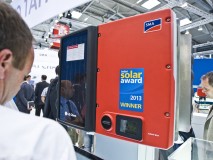
At this year’s Intersolar exhibition, SMA introduced the first mass-produced, wall-mounted PV inverter with an integrated battery and was promptly presented with an Intersolar AWARD, and for good reason: Together with the Sunny Home Manager, the Sunny Boy Smart Energy is designed to increase self-consumption of solar electricity in private homes by more than 50… read more

1 Kommentar
Mir erschien es nach dem Besuch der Intersolar Europe in der Tat so, als wäre mit den Speichern eine Technik gefeiert worden, die ihren Durchbruch bereits geschafft hat. Das ist aber nicht so, und deswegen wirft dieser Beitrag hier durchaus treffend Fragen auf. Schafft die Industrie die Herausforderungen? Senkt sie rapide Kosten? Schafft sie die nötigen EMS? Was ist mit dem Smart Grid? Bevor die Branche Speicher als Eckpfeiler der Energiewende feiert, muss sie erst kräftig innovieren.