Tags
Blogroll
OVERVIEW
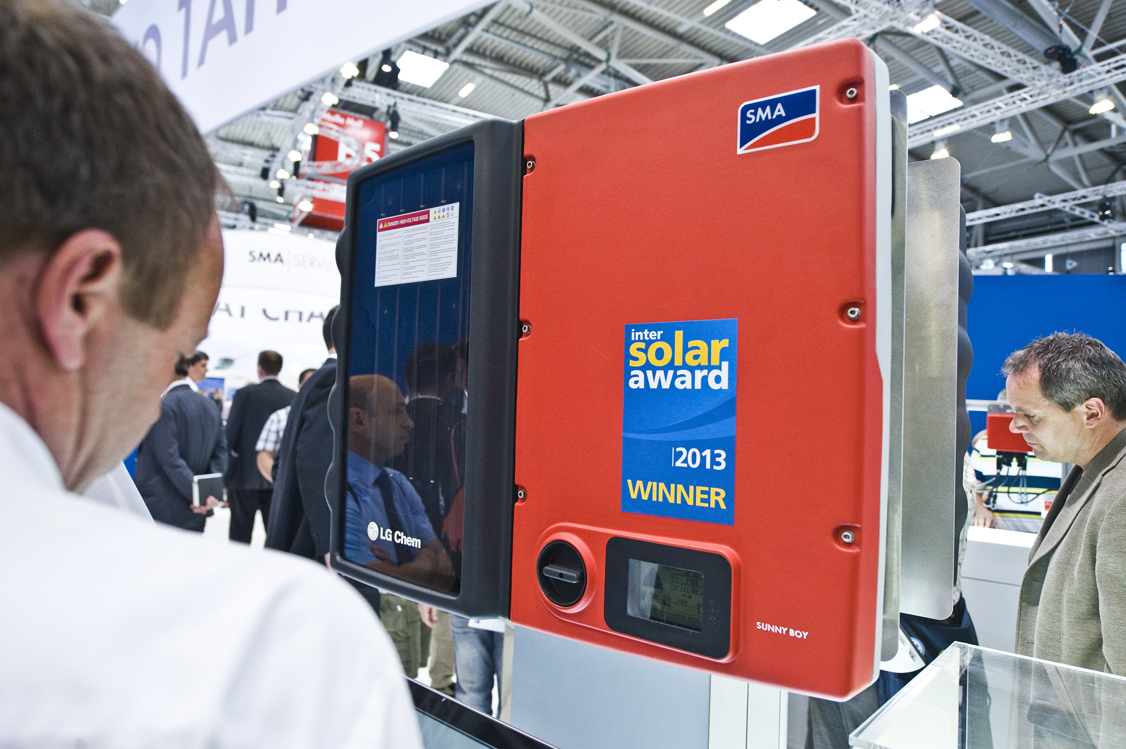
Sunny Boy Smart Energy from SMA at Intersolar Europe 2013 (Foto: © SMA Solar Technology AG)
At this year’s Intersolar exhibition, SMA introduced the first mass-produced, wall-mounted PV inverter with an integrated battery and was promptly presented with an Intersolar AWARD, and for good reason: Together with the Sunny Home Manager, the Sunny Boy Smart Energy is designed to increase self-consumption of solar electricity in private homes by more than 50 percent – with minimal costs. But is this just hype or the real deal? Well, as the Sunny Boy Smart Energy will not be available until the second half of 2013, so far there is no practical evidence to back up these claims. Reason enough for me to ask SMA just how Sunny Boy Smart Energy is going to live up to this early acclaim.
Stored Electricity Still Too Expensive Per Kilowatt Hour
For many PV system operators the decision to take an active role in the energy transition by producing their own solar electricity is of course motivated by environmental concerns, however one cannot deny that these systems are also implemented to earn – or at least not lose – money. The fact that – despite the 500 subsidy applications that have already been submitted – electricity storage systems are currently most likely to be thought of as a losing financial proposition is plain to see from the current reticence of potential buyers, and there is good reason for this assessment. Even after subtracting the subsidy available to buyers from the costs of the new PV plant and storage system, customers can still expect to pay around €8,000 for a 10 kilowatt (kW) rechargeable lead-acid battery. Moreover, if we continue our calculations on the basis of 5,000 charging cycles, a depth of discharge (DoD) of 90 percent and a system efficiency of 90 percent, this still results in additional costs of around €0.25 per kilowatt hour (kWh) for stored solar electricity. Given these key electricity storage figures, it is no exaggeration to say that many would find it difficult to believe that the Sunny Boy Smart Energy from SMA can really make up enough ground here.
The Dilemma of Increased Self-Consumption
As a result, SMA has taken a different approach, instead opting for a much smaller lithium-ion battery with a capacity of around two kilowatt hours, which is a much cheaper solution, easier to control via Sunny Home Manager and directly coupled to the PV inverter. This solution does not try to deliver the maximum possible increase in self-consumption but instead seeks to run in the most economically viable fashion. With this approach, the developers of Sunny Boy Smart Energy have managed to get around the problem of larger storage systems, of which the storage utilization efficiency decreases with increasing self-consumption leading to higher incremental costs per additional kilowatt hour stored. In practice, this dilemma can be seen, for example, when a large storage system for solar electricity can only be fully charged on high-yield days but cannot not be fully discharged at night, particularly during the summer when the nights are short. In this case, customers would basically be paying money for unused storage capacity.
Electricity Pricing Scheme an Opportunity for Sunny Boy
So, the SMA storage system already scores in terms of its basic concept, but what about the actual costs? Unfortunately, we were unable to get a precise answer from SMA about the prices that PV operators can expect. In their response, SMA merely stated that, based on a typical self-consumption rate of 55 percent (based on an annual PV generation of 5,000 kWh and an annual electricity consumption of the same amount as well as use of a Sunny Home Manager), the overall costs per stored kWh based on a storage system throughput of more than 8,200 kWh, a battery life of 10 years and a storage system efficiency of more than 90 percent are up to 50 percent lower than with conventional storage systems. If we add the initial costs per kWh of solar electricity, this could indeed end up being less than the price per kWh of domestic electricity obtained from the grid. Given the current electricity pricing scheme, it might well pay off to install Sunny Boy Smart Energy straight away. Once prices for PV modules and costs of lithium-ion batteries drop further and electricity prices continue to rise, the SMA storage system will probably be one of the first economically viable storage systems for PV electricity.
No Shortage of Innovation in the Solar Industry
But it is not only the storage concept that could enable Sunny Boy Smart Energy to crack the break-even point. Even in terms of design, SMA has focused on economic viability. The storage system requires less space and, with a total weight of less than 30 kg, it can be installed by a single technician working alone, similarly to an inverter. As the system is already coordinated with the corresponding SMA inverter, there is no need for a separate battery design. While this all sounds great, we will probably have to wait until 2014 to see whether or not the Sunny Boy Smart Energy system actually manages to establish itself in the market. One thing we can be certain of is that the competition never sleeps. Some are putting their faith in the latest battery technology, while others even offer storage systems for solar electricity with bicycle batteries. Recently, the solar industry has been repeatedly criticized for its lack of innovation, but now, even with subsidies being phased out, there is clearly no shortage of ideas on how to further establish PV technology as the central pillar of the renewable energy revolution in Germany.
Related Posts
For photovoltaics to play a leading role in the energy transition, energy storage systems need to reduce the burden on the grid and provide operating reserves, as well as being equipped with an intelligent energy management system that coordinates their usage. Will the industry succeed in developing the necessary technical solutions? In a renewable power… read more
Does the grid really need batteries? This is currently a very controversial question. Some experts even consider the technology to be detrimental and that’s why they are strictly rejecting Germany’s planned incentives. Fraunhofer Institute for Solar Energy Systems (ISE) counters this argument in its new Speicherstudie 2013 (study on storage systems): Batteries can actually take… read more
Interest in solar installations with storage systems is rising because these systems reduce consumer dependency on utility companies. So far, there has been little investment into the new technology due to high battery costs – but this may soon change: Thanks to higher production rates and technical advances, costs are sinking fast. It’s always the… read more

With their tried-and-tested technology and relatively low purchase price, lead-acid batteries should, for all intents and purposes, be playing a key role in the up-and-coming market for photovoltaic storage systems. However, the majority of suppliers are putting their trust in the less thoroughly tested yet higher-performance lithium-ion batteries instead. Will lead-acid storage systems become obsolete… read more

1 Kommentar
Es scheint mir, dass die entwicklungstechnischen und wirtschaftlichen Überlegungen bei der Speicherung von Strom die Batterien in Elektroautos mit einbeziehen sollten. Leider gibt es bisher keine Systeme dieser Art auf dem 230 Volt Markt zu kaufen, obwohl wahrscheinlich in Zukunft ein größerer Markt als für stationäre Speicher vorhanden ist. Ich jedenfalls wäre einer der ersten Kunden für ein solches System – und wäre sogar bereit bei einer Testphase mit meiner 7 kWh Anlage behilflich zu sein.