Tags
Blogroll
OVERVIEW
Flexible use, easy modular expandability as well as cost efficiency and nonuse of toxic materials. These are crucial features, which have to be addressed by the manufacturers to further boost the deployment of electrical energy storage solutions. In order to illustrate the efforts of the industry to meet these needs, we will shed light on three innovative solutions in this blogpost.
According to energy experts and industry representatives energy storage is currently one of the greatest challenges in energy policy and will make a decisive contribution to the success of the energy turnaround. New solutions and products are therefore demanded stronger than ever.
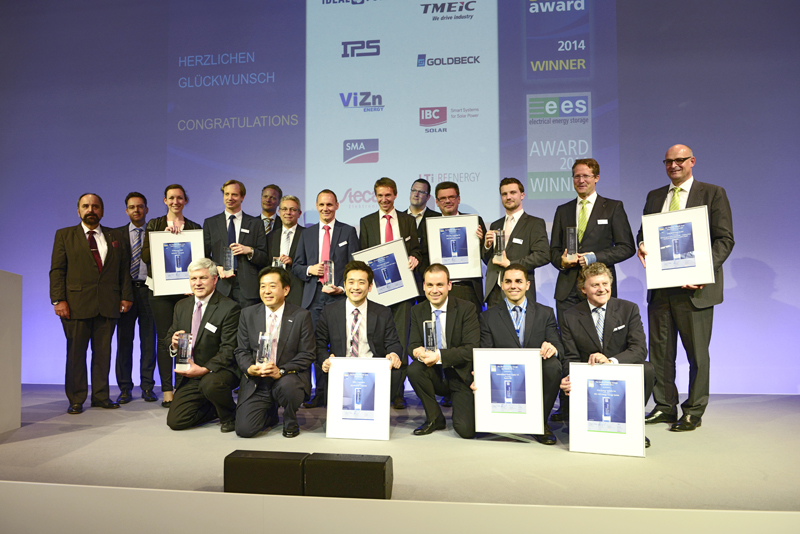
Against this background innovative manufacturers recently received the electrical energy storage (ees) AWARD during the Intersolar Europe 2014 fair, showing that today batteries can be produced cost-effectively yet are nontoxic and suitable for many different applications.
The ees jury selected their assessment criteria according to market challenges which included not only the level of technological innovation but also the benefits for industry, the environment, and society as well as economic efficiency and proof of the level of innovation.
In order to honor new groundbreaking solutions the jury selected three companies from Europe and the USA for their innovative approach – But what are the beneficial features of the award winners in detail?
Highly flexible application
The first innovation I’d like to introduce is the 30 kW hybrid PV storage converter by the Texan Ideal Power Inc. The solution convinced the jury of independent storage experts because it’s wide range of application.
The converter IHC- 30kW-480 combines PV and battery at a high DC voltage level and stands out with an efficiency level of up to 97%. A further operating voltage of 450 to 1,000 V DC provides an extremely high level of flexibility.
According to the experts other advantages are the modular set-up as well as the mobile fields of application, particularly in off-grid systems. So, on the one hand the system works as a classical energy storage system which stores electricity generated from a PV system and on the other hand the system is designed to charge electric vehicles.
If you are interested in further details about the solution, the energy storage magazine ees International conducted an interview with the company.
Exeron: The “Off-Grid Beast”
The variety of practical applications was also key in awarding the second innovation illustrated in this blogpost. The solution particularly addresses the growing need for off-grid application in remote areas.
The Bulgarian International Power Supply Ltd. from Sofia showcased “an optimal system for off-grid use in the form of the Exeron MX, which fulfils all requirements surrounding energy management, communication and modularity, the experts stated.
Optimized controller designs enable different energy sources like sun, wind, diesel generators or even the grid to be combined. With stringent modular design, easy-to-maintain hot plug technology, advanced lead battery management as well as the increased availability thanks to system redundancy, the solution convinced the ees Award jury.
The systems central control unit can combine up to 16,380 single storage modules with a capacity of 2 kW each. This makes an overall capacity of 65 MW and makes the Exeron system – nicknamed “The Off-Grid Beast” – working as a grid-connected as well as an off-grid application.
If you are interested in further details about the solution, the energy storage magazine ees International conducted an interview with the company.
Non-toxic and cost efficient
Last but not least the third innovation brings along special benefits regarding its environmental impacts.
Housed in a 20ft shipping container the ViZn Z20 Energy Storage System by ViZn Energy Systems, Montana, USA, uses a new redox-flow battery technology for commercial applications from 160 kWh.
The well-designed, ecological prototypes, which mostly avoid the use of dangerous substances in storage systems, especially impressed the jury. Moreover the non-acid zinc/iron cell chemistry makes it possible to produce the battery system very cost efficiently.
New patent applications underpin the system’s innovative strength. The use of inexpensive raw materials translates to the potential for considerable cost reductions, particularly in comparison with today’s vanadium redox-flow technology.
According to the manufacturer the actual cost lies below US$450 per kWh. This makes the system an attractive alternative to conventional diesel generators. Target group of such application is of course the commercial and industrial segment.
If you are interested in further details about the solution, the energy storage magazine ees International conducted an interview with the company.
Related Posts

Energy storage and grid integration are two of the areas on which efforts towards the further expansion of solar power supply are centered. The increasing share of solar power is changing the power grid. That is why efficient energy storage systems will play a vital role in overcoming the current challenges – initially by integrating… read more
For photovoltaics to play a leading role in the energy transition, energy storage systems need to reduce the burden on the grid and provide operating reserves, as well as being equipped with an intelligent energy management system that coordinates their usage. Will the industry succeed in developing the necessary technical solutions? In a renewable power… read more

The fight against climate change will be decided in the large cities, say the experts. The idea is therefore to connect wind energy and solar installations intelligently with other power sources and consumers in conurbations. But this requires smart control and energy storage systems that remove some of the burden from the power grid. Will… read more
The service life of energy storage solutions depends not only on cell chemistry but also on external influences. Properties which are a must for rechargeable batteries in consumer electronics and mobile applications are less relevant in stationary batteries such as solar energy storage systems. Factors like ambient temperature, depth of discharge and cycle stability have… read more
